Showing posts with label Modernism. Show all posts

Sunday, July 6, 2008

A Bowl of Noodles and 20 Cents

I received this story through the e-mail:

There was once a priest who was newly transferred to a parish in Perak. Some days after his arrival, finding the food brought to him a little too spicy for his palate, he went to the local coffee shop to have a nice meal of Chinese rice noodle soup. Of course, he wore street clothes, as do all the Catholic priests in Malaysia.

He sat down at one of the run down tables and began to read the morning paper. Soon enough, the hawker brought a steaming hot bowl of noodles to him. Not paying much attention, he paid for the noodles and the hawker put the change down on the table.

As he ate the first spoonful, he found the soup too watery and the noodles overcooked and soggy. He was disappointed with the dish, as after hearing the locals rave about it for the past few days, he had expected better. Well, to be honest, being from Penang where the food is glorious, he was bound to be disappointed no matter where he went. Anyway....

After finishing his meal, as he picked up his change, he realized that the man had returned him 20 cents extra. As he considered what to do, he thought to himself, "You'd better give the 20 cents back. It's not right to keep it." Then he thought, "Forget it, it's only 20 cents and anyway, the food was horrible and not at all what it was made out to be. Who's going to bother about 20 cents? And look, the man is so busy cooking. It might disturb him if I were to interrupt. Let me just take it as a gift from God and keep quiet."

So he made his way out of the shop. But as he passed the stall, he paused momentarily and then handed the 20 cents to the man and said, "Hey boss, you gave me 20 cents extra change".

The hawker smiled and replied, "You're the new parish priest right? I haven't been going to church for a number of years now because of a bad experience I had. I just gave you the extra change to see what you would do and whether you are also a hypocrite like the rest of them. I think I will be coming to see you soon."

The priest rushed back to the Church and fell to his knees before the Blessed Sacrament. "Sweet Jesus!", he said, in tears, "Judas betrayed you for 30 pieces of silver buy I almost sold you for 20 cents! My example might have caused a soul to be lost!"

Most non-Christians will probably never read the bible. But they will read us and all the other Christians they come across. Our lives and our actions will be only Scripture they will ever read and we are closest encounters they will have of the Lord Jesus.

What we say and more importantly, what we do will determine what others think of the Church, the Faith and Our Lord. Are we just hypocrites? Have we, through our words and actions, through our commissions and omissions, led others to have a bad impression of the Lord? Have we driven someone away from Jesus?I think we have all, at some point and some more than others, have been guilty of this. And for this sin, we need to beg the Lord's forgiveness and resolve to better represent the Lord who has made us, through our baptism, ambassadors of Christ. May we be Christ to others and let the Light of Christ shine through us.

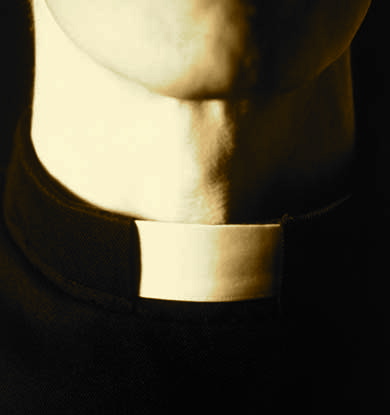
Post Script: The priest, shaken by this experience, has taken to wearing his cassock and collar in public, both as a sign of his calling to others and, primarily, as a sign of his own calling and consecration to himself. His vesture reminds him daily, at all times, of his identity and his own vocation as a priest and as a Christian and reminds him that his actions as a minister of Christ and the Church are a sign to others as well. It reminds him that people, and God, are watching.

Friday, May 2, 2008

Nihil Innovatur

The strangest things are happening to the rubrics of the Mass!
Old men like me don’t understand we thought our days would pass
Without disturbance of the way we learnt to celebrate.
Now worship, like the world itself, is in a dreadful state.

Some time ago the priest was sure of what was his to say,
And also that the altar-boys would answer up his way:
Now anything can happen from a hold up to a strike,
Or someone making comments through a nuisance-making mike.

The people used to keep their place, and did not interfere,
Except perhaps to cough or sneeze or snore, But only in the rear:
They wouldn’t dream of singing out or butting in with noise,
Or talking up in Latin like the Clerk and altar-boys.

Young Curates now don’t seem to mind if Mass is started late,
Provided that the people who are there “participate”:
And some would like motets, and psalms and hymns and chants
Distracting to the celebrant and pious maiden aunts.

A plague upon those liturgists and all their fussy ways.
There’s nothing solid in them, ’tis a passing whim or craze:
Old men like we have battled for our faith and fatherland
With nothing but the Scripture and the Sacraments in hand.

Of course we had the Liturgy, a makeshift to be sure,
And more or less a native growth, but still Tradition pure;
We said the Mass and let the people pray as best they could.
That was the way in Penal times, and surely it was good.

"The world is moving on, no doubt, and times have changed a lot.
The Church of Christ must follow - if her net is in a knot.
She’ll never catch the fishes that are milling round the boat:
She needs a change of tackle, sweeter bait and lighter float."

So say professors and divines, who ought to know a lot:
Perhaps old trowlers like myself should try to change our trot:
I’ll read that journal “Worship” and some book on Liturgy,
And maybe when I understand ‘twont seem bizarre to me.


Father Fennelly, circa 1956

1956! Imagine what shock it must have been to this Father - and to whoever who had read this prophetic poem - when all that it contains came to pass 10 years later!

Tuesday, November 27, 2007

Religious Liberty?

Even the Protestants said no.

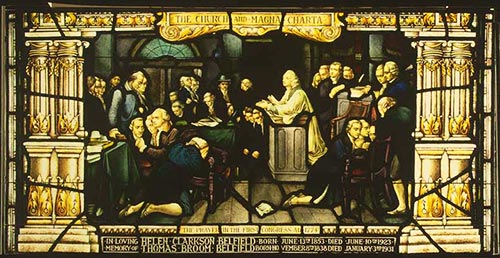
Initially, Thomas Cushing, one of the delegates and Founding Fathers of the United States of America, suggested that an inter-religious prayer be said together before the inaugural session of the Continental Congress on 6 September 1774 at Carpenters' Hall in Philadelphia.

The Prayer in the First Congress

However, John Jay of New York and John Rutledge from South Carolina raised their objection. A certain John Adams later wrote to his wife, Abigail, explaining that the opening prayer was practically impossible "because we were so divided in religious sentiments" and thus "we could not join in the same act of worship".

Many of the Founding Fathers gathered at the Congress are clearly from different Protestant sects, including Episcopalians, Congregationalists, Presbyterians, just to name a few.

Even the Protestants from the different brands and branches of Protestantism do not recognise themselves as a collective group of Christians, as a united 'Body of Christ', as the universal Church of God. They see the differences in doctrines and beliefs, and henceforth conclude that they cannot, in good conscience, pray and worship together. Doesn't this tell us something?

(Sadly), the Modernists' idea of religious liberty set in, as noted by the same John Adams, that a certain "Mr S Adams arose and said he was no bigot, and could hear a prayer from a gentleman of piety and virtue who was at the same time a friend to his country". In the end, "the motion was seconded and passed in affirmative".

Modernism is not a modern concept at all. Be reminded that this took place in 1774.

Saturday, November 24, 2007

The Miracle of Our Lady of Fatima

Old, traditional Catholic movies are the best.

And this one is not an exception. Here are some excerpts compiled from this beautiful movie:


Our Lady did not, and will never, lie. The Miracle of the Sun did happen on the thirteenth day of October that same year.

How beautiful is the Regina Caeli to Our Blessed Mother! Listen to how fervently, how piously the peasants pray and sing to Our Lady in the movie! With how much more faith and reverence must to those happy souls who are present be praying and singing on that blessed day!
On Cova da Ira, the spot where the Apparitions of Our Blessed Lady took place, stands a magnificent Basilica. But woe to the unhappy Modernists, who desecrated the Sanctuary sanctified and consecrated by the Mother of God herself by allowing the pagans, the Hindus in particular, to worship and perform rituals to their idols there! Woe, woe to them!

The Procession to the Sanctuary.

Prayers of reparation for the desecration of the Sanctuary, led by the four Bishops.

The Bishops of the Society of St Pius X led thousands of pilgrims in 2005 to the Sanctuary of Our Lady of Fatima to make reparations for the desecrations. Tradition triumps over the Modernism, as the attempted interruption by the singing of the Novus Ordo nuns only encouraged the pilgrims to pray even louder the prayers of the Holy Rosary.

Let us continue to make reparations to the Immaculate and Sorrowful Heart of Mary in our daily prayers!

Caveat: Your blogger does not support all the information from of the linked parent site.

Thursday, November 1, 2007

Instaurare Omnia in Christo!

How can the saints, particularly those bathed in the blood of martyrdom, who have suffered and died for the propagation of the Holy Faith ever imagine the cancerous concepts of Modernism ravaging through so many members of the Mystical Body of Christ, nay, even the very heart - the Magisterium, in the present years?

United with the spirit and intention of the late Archbishop (felicis memoriae), we are bound by our moral obligations to echo the Declaration that he had made publicly, and courageously, back in 1974.

Archbishop Marcel Lefebvre, Defender of the Catholic Faith

Declaration of November 21, 1974:

“We adhere with all our heart and all our soul to Catholic Rome, guardian of the Catholic Faith and of the traditions necessary for the maintaining of that Faith, to eternal Rome, mistress of wisdom and of truth. On the contrary, we refuse, and we have always refused, to follow the Rome of neo-Modernist and neo-Protestant tendencies, which showed itself clearly in the Second Vatican Council and in the reforms that issued from it.”

Archbishop Marcel Lefebvre

And also, this:

The Oath Against Modernism

I, (...), firmly embrace and accept each and every definition that has been set forth and declared by the unerring teaching authority of the Church, especially those principal truths which are directly opposed to the errors of this day. And first of all, I profess that God, the origin and end of all things, can be known with certainty by the natural light of reason from the created world (see Rom. 1:90), that is, from the visible works of creation, as a cause from its effects, and that, therefore, his existence can also be demonstrated: Secondly, I accept and acknowledge the external proofs of revelation, that is, divine acts and especially miracles and prophecies as the surest signs of the divine origin of the Christian religion and I hold that these same proofs are well adapted to the understanding of all eras and all men, even of this time. Thirdly, I believe with equally firm faith that the Church, the guardian and teacher of the revealed word, was personally instituted by the real and historical Christ when he lived among us, and that the Church was built upon Peter, the prince of the apostolic hierarchy, and his successors for the duration of time. Fourthly, I sincerely hold that the doctrine of faith was handed down to us from the apostles through the orthodox Fathers in exactly the same meaning and always in the same purport. Therefore, I entirely reject the heretical' misrepresentation that dogmas evolve and change from one meaning to another different from the one which the Church held previously. I also condemn every error according to which, in place of the divine deposit which has been given to the spouse of Christ to be carefully guarded by her, there is put a philosophical figment or product of a human conscience that has gradually been developed by human effort and will continue to develop indefinitely. Fifthly, I hold with certainty and sincerely confess that faith is not a blind sentiment of religion welling up from the depths of the subconscious under the impulse of the heart and the motion of a will trained to morality; but faith is a genuine assent of the intellect to truth received by hearing from an external source. By this assent, because of the authority of the supremely truthful God, we believe to be true that which has been revealed and attested to by a personal God, our Creator and Lord.

Furthermore, with due reverence, I submit and adhere with my whole heart to the condemnations, declarations, and all the prescripts contained in the encyclical Pascendi and in the decree Lamentabili, especially those concerning what is known as the history of dogmas. I also reject the error of those who say that the faith held by the Church can contradict history, and that Catholic dogmas, in the sense in which they are now understood, are irreconcilable with a more realistic view of the origins of the Christian religion. I also condemn and reject the opinion of those who say that a well-educated Christian assumes a dual personality-that of a believer and at the same time of a historian, as if it were permissible for a historian to hold things that contradict the faith of the believer, or to establish premises which, provided there be no direct denial of dogmas, would lead to the conclusion that dogmas are either false or doubtful. Likewise, I reject that method of judging and interpreting Sacred Scripture which, departing from the tradition of the Church, the analogy of faith, and the norms of the Apostolic See, embraces the misrepresentations of the rationalists and with no prudence or restraint adopts textual criticism as the one and supreme norm. Furthermore, I reject the opinion of those who hold that a professor lecturing or writing on a historico-theological subject should first put aside any preconceived opinion about the supernatural origin of Catholic tradition or about the divine promise of help to preserve all revealed truth forever; and that they should then interpret the writings of each of the Fathers solely by scientific principles, excluding all sacred authority, and with the same liberty of judgment that is common in the investigation of all ordinary historical documents.

Finally, I declare that I am completely opposed to the error of the modernists who hold that there is nothing divine in sacred tradition; or what is far worse, say that there is, but in a pantheistic sense, with the result that there would remain nothing but this plain simple fact-one to be put on a par with the ordinary facts of history-the fact, namely, that a group of men by their own labor, skill, and talent have continued through subsequent ages a school begun by Christ and his apostles. I firmly hold, then, and shall hold to my dying breath the belief of the Fathers in the charism of truth, which certainly is, was, and always will be in the succession of the episcopacy from the apostles. The purpose of this is, then, not that dogma may be tailored according to what seems better and more suited to the culture of each age; rather, that the absolute and immutable truth preached by the apostles from the beginning may never be believed to be different, may never be understood in any other way.

I promise that I shall keep all these articles faithfully, entirely, and sincerely, and guard them inviolate, in no way deviating from them in teaching or in any way in word or in writing. Thus I promise, this I swear, so help me God...

Given by His Holiness St. Pius X September 1, 1910.

Most unfortunately, this Oath, which is to be sworn to by all clergy, pastors, confessors, preachers, religious superiors, and professors in philosophical-theological seminaries, has lost its use in the Post-Conciliar church.

So help us God...

Attention: Due to some technical errors, I am no longer able to maintain my previous blog. With this new blog up and running, the legacy of un roi, une loi, une foi continues.