Showing posts with label Our Blessed Lord. Show all posts

Friday, June 6, 2008

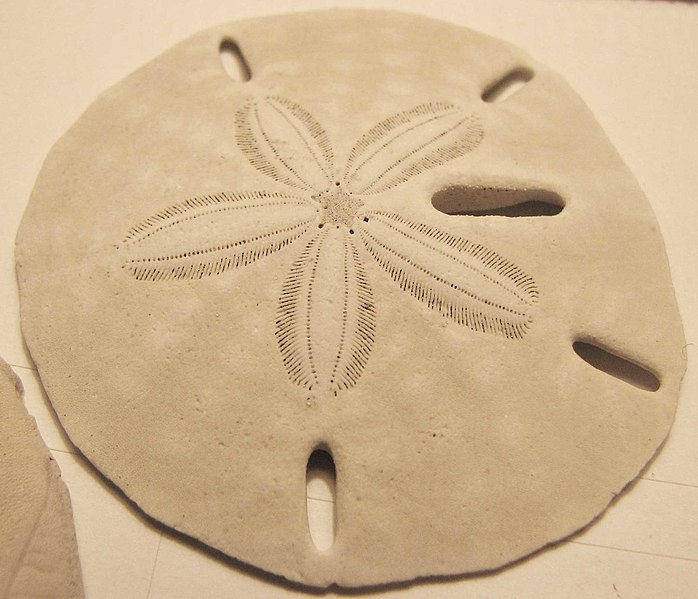
The Legend of the Sand Dollar

There's a pretty little legend
That I would like to tell -
Of the birth and death of Jesus
Found in this lowly shell.

If you examine closely,
You'll see that you find here
Four nail holes and a fifth one
Made by a Roman's Spear.

On one side the Easter Lily,
Its center is the star
That appeared unto the shepherds
And led them from afar.

The Christmas poinsettia
Etched on the other side
Reminds us of His birthday
Our Happy Christmastide.

Now break the centre open
And here you will release
The five white doves awaiting
To spread Good Will and Peace.

This simple little symbol,
Christ left for you and me
To help us spread His Gospel
Through all eternity.

Anonymous

Thursday, May 22, 2008

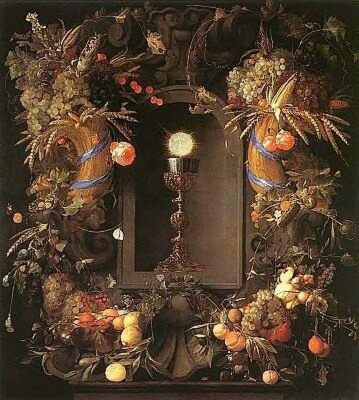
Feast of Corpus Christi

O Lord, I Am Not Worthy

O Lord, I am not worthy
That Thou should'st come to me,
But speak the words of comfort,
My spirit healed shall be.

O, come, all you who labor
In sorrow and in pain,
Come, eat This Bread from heaven;
Thy peace and strength regain.

O Jesus, we adore Thee,
Our Victim and our Priest,
Whose precious Blood and Body
Become our sacred Feast.

O Sacrament most holy,
O Sacrament divine!
All praise and all thanksgiving
Be ev'ry moment Thine.

The Latin Church celebrates this venerable Feast in honour of Our Blessed Lord in the Most Holy Eucharist on the Thursday after Trinity Sunday. We profess that He is truly present, Body, Blood, Soul and Divinity, in the Most Blessed Sacrament.

It is indeed an exceedingly meritorious Act of Faith, when, at the Elevation of the Sacred Host after Consecration, we look at It, and, bending low and prostrating in spirit, we adore the Eucharistic Lord, saying, 'Dominus meus, Deus meus!', following the words of the Doubting, now St Thomas. It is by these our eyes of faith, and not our bodily eyes, that we see and recognise that Our Divine Saviour is there, right there in the Consecrated Bread, and for that, He will bless us abundantly, as He promised: Blessed are they that have not seen, and have believed. It is on this day of the Feast of Corpus Christi that we renew this faith in Our Lord's Real Presence in the Holy Eucharist, professing this truth which the heretics reject.

Protestants deny Our Lord's omnipotence when they refuse to believe that He is truly present in the Consecrated Species. This heresy is not new, and more certainly, it is not unique to these heretics - this same truth had been denied by the faithless Jews during the time of Our Lord Jesus Christ. When Our Lord did proclaim Himself to be the Bread of Life that came down from Heaven, the unbelieving Jews scoffed at Him.

The Jews therefore murmured at him, because he had said: I am the living bread which came down from heaven. And they said: Is not this Jesus, the son of Joseph, whose father and mother we know? How then saith he, I came down from heaven?

St John 6:41, 42

Our Divine Lord continued:

Then Jesus said to them: Amen, amen I say unto you: Except you eat the flesh of the Son of man, and drink his blood, you shall not have life in you. He that eateth my flesh, and drinketh my blood, hath everlasting life: and I will raise him up in the last day. For my flesh is meat indeed: and my blood is drink indeed. He that eateth my flesh, and drinketh my blood, abideth in me, and I in him. As the living Father hath sent me, and I live by the Father; so he that eateth me, the same also shall live by me.

St John 6:54-58

"Our Lord's words are metaphorical!", a Protestant will argue vehemently. Why, then, seeing that a large group of His followers, unable to accept this precious teaching and truth, were leaving Him, He made no effort to clarify Himself, if what He said to the Jews were intended to be in metaphors? He knows full well that those who left Him will not be saved, for we know that Jesus Christ is the only Way to the Father.

It is also important to note that when Our Lord expounded on teachings of particular importance, He would begin by saying, 'Amen, amen, I say unto you.' It calls for special emphasis on the truths He was to expound. In His short public ministry of three years, His Mission is to teach as much as possible and expound the truths most necessary for salvation. When using parables or metaphors, Our Divine Lord would have stated it so clearly and explicitly that it is impossible for anyone to think otherwise. He is God, He is Almighty - He is not the fuzzy-wuzzy street-preacher you would expect standing at the corner of Orchard Road.

If any one shall say that, in the most holy sacrament of the Eucharist, there remains the substance of bread and wine together with the body and blood of our Lord Jesus Christ; and shall deny that wonderful and singular conversion of the whole substance of the bread into the body, and of the whole substance of the wine into the blood, the species of bread and wine alone remaining, which conversion the Catholic Church most fittingly calls Transubstantiation, let him be anathema.

Council of Trent - Session 13, Canon 2

Blessed be Jesus in the Most Holy Sacrament of the Altar!

Sunday, April 6, 2008

咩!

meh! meh! meh!

A friend of mine commented: "Why do you like to meh so much? Is it because God is your Shepherd, and you are His sheep?"

I have never thought of that!

As Catholics, we are the sheep and lambs in His fold. We ourselves are called to give all our heart, mind and soul - to offer our entire being - to our Lord God, Who sent His Only-Begotten Son, the Lamb of God, to be sacrificed for our sake on the Tree of the Cross.

Being the Second Sunday after Easter, or more commonly known as Good Shepherd Sunday, after the theme of the Epistle and Gospel of the Holy Mass celebrated today, Holy Mother Church reminds her children of the importance of true ecumenism - the calling of all men into the Catholic Church, in the flock of our Lord Jesus Christ, of Whom our Holy Father, Pope Benedict XVI, is His current Vicar on earth.

The shepherd stave, or crosier, borne by the Good Shepherd in the image above, is similar to the ones carried by prelates of the Church. From the Catholic Encyclopedia, the learned Durandus and Barbosa tell us of the significance of these ecclesiastical ornaments conferred on bishops during their consecration:

(They) signify their authority to correct vices, stimulate piety, administer punishment, and thus rule and govern with a gentleness that is tempered with severity. (...) As the rod of Moses was the seal and emblem of his Divine commission as well as the instrument of the miracles he wrought, so is the episcopal staff the symbol of that doctrinal and disciplinary power of bishops in virtue of which they may sustain the weak and faltering, confirm the wavering in faith, and lead back the erring ones into the true fold. (...) The end is sharp and pointed wherewith to prick and goad the slothful, the middle is straight to signify righteous rule, while the head is bent or crooked in order to draw in and attract souls to the ways of God.

Throughout the history of Christianity, holy images or statues of Our Lord as the Good Shepherd can be found in many hallowed grounds, from dark catacombs to glorious Gothic cathedrals. It is indeed one of the most well-loved titles of our Blessed Lord.

Tuesday, February 19, 2008

Via Crucis

Jésus-Christ Monte au Calvaire

Jésus-Christ monte au Calvaire,
Il y va pour y mourir.
Suivons-le, c'est notre frère,
Qui pour nous, voulut souffrir.
En mourant, il nous délivre
Du fardeau de nos péchés,
Et celui qui veut le suivre,
Sous la Croix devra marcher.

Chez Pilate, on le compare
Au dernier des scélérats.
Que dis-tu, peuple barbare?
Tu réclames Barabbas!
Quelle indigne préférence;
Le coupable est pardonné
Et malgré son innocence,
Jésus-Christ est condammé.

Mais voici que l'on présente
Une Croix au doux sauveur,
Sur sa chair encor sanglante,
Elle ajoute à ses douleurs.
Et pourtant il la désire,
Il la veut depuis toujours,
Depuis toujours elle attire
Son regard brûlant d'amour.

Ô Jésus, vos mains calleuses,
Ont manié bien d'autres bois.
Vos épaules laborieuses
Ont plié sous d'autres poids.
Il est donc bien redoutable
Ce fardeau, mon doux Jésus,
Puisque ce poids vous accable
Et que vous n'en pouvez plus.

Au chemin de la souffrance
Pour l'aider, Marie est là;
Elle veut par sa présence
Soutenir ses derniers pas.
Ô Vierge, en notre faiblesse,
Nous avons besoin de vous,
Puisque nous tombons sans cesse
Demeurez tout près de nous.

Quand Simon, l'un de mes frères
Est choisi pour te porter;
Ô Croix, tu parais légère,
Qui voudrait se dérober?
Pour la tâche, Ô divin maître,
S'il vous faut des ouvriers,
Me voilà, de tout mon être,
Je suis prêt à vous aider.

Tous vos traits, par la souffrance
Sont creusés de durs sillons;
Nos péchés et nos offenses
Sont gravés sur votre front.
Souvent, on déforme encore
Votre image autour de nous;
Au monde qui vous ignore
Nous saurons parler de vous.

Votre pied heurte la pierre:
Vous tombez sur le chemin;
Votre sang dans la poussière
La marque d'un sceau divin.
Ô Jésus, je vous adore
Étendu sous votre Croix;
Prosterné, je vous implore,
Moi qui tombe tant de fois.

"Vous pleurez sur mes souffrances,
Pleurez donc sur vos péchés.
Puisque c'est pour vos offenses
Que mon sang sera versé
Suivez-moi vers le calvaire
Avec moi, sachez offrir
Vos souffrances pour vos frères:
Après moi, il faut souffrir.
"

A quoi bon tant de souffrance,
A quoi bon verser son sang,
Quand Il voit la foule immense
De pécheurs impénitents.
Et pourtant, Il se relève,
Prend la Croix à pleines mains,
Il poursuit et Il achève
Jusqu'au bout le dur chemin.

On dépouille votre taille,
Et plus rien pour vous couvrir.
Né jadis nu sur la paille,
Vous voici, nu, pour mourir.
Enseignez à tous vos frères
L'amour de la pauvreté;
Que les biens de cette terre
Sont toujours à mépriser.

A grands coups, le marteau frappe
Dans la chair, rivant les clous;
Comme une divine grappe
Que l'on presse sous les coups.
De ses mains, le sang s'écoule,
De ses mains qui, si souvent.
Ont béni d'immenses foules
Et guéri tant de souffrants.

Voici donc l'instant suprême,
Qu'il attend depuis toujours
De prouver à ceux qu'il aime,
Jusqu'où va son grand amour.
Embrassant la terre entière,
Ses deux bras sont étendus;
Il appelle tous ses frères
Et Il meurt pour leur salut.

En vos bras, quand on vous livre
Votre Fils inanimé,
Vous lisez comme en un livre
Sur son corps tous nos péchés.
Dites-nous, ô tendre Mère,
Tout ce que vous avez vu;
Gravez en nos cœurs de pierre
Les blessures de Jésus.

L'ennemi de votre gloire
Peut sourire, il est vanqueur
Et pourtant votre victoire
Est certaine, Ô mon sauveur.
Malgrè la nuit de la tombe,
Le linceul sur votre Corps,
Aujourd'hui l'enfer succombre
Vous avez vaincu la mort.

Sunday, January 13, 2008

Sunday, January 6, 2008

Hail, Three Kings!

As the Holy Mother Church celebrates the blessed Feast of the Epiphany this day, we also commemorate the arrival of the Three Kings, or Magi, from the Far East, to the humble manger where the Sweet Infant of Bethlehem laid. Here, they bowed down before their Creator, adoring Him, offering Him their gifts of gold, frankincense and myrrh.

It would be interesting to note that each of these three gifts are symbolic of our disposition and the spiritual gifts that we ought to offer and present to our Lord God this day, nay, daily for all our lives.

Our material possessions in our earthly course ought not to be a hindrance to prevent us from attaining our spiritual perfection, so that we may come at last to the Happy Home where we have, through the sin of our First Parents, denied ourselves. Hence, all our material goods and belongings, which the gold represents, should all help us and direct us to our Last End, that is, the glory and eternal bliss of Heaven, and the beatific vision of God.

The frankincense is a symbol of our prayers. For if our prayers are sincere and truthful, they shall ascend and penetrate, like a sweet odour, through the clouds to reach the Throne of the Most High.

Our Lord did not promise us riches and joy in this our earthly pilgrimage. Instead, He called, and continues to call us, to penance every single day. Myrrh, a bitter substance, is a symbol of the self-denial and mortification of our passions that we must still practised daily, in order for us to attain to the best of our abiliites the spiritual perfection that God requires of us, so that we may deserve to enter His Kingdom.

During the Holy Mass this day, the Church reminds us of the three-fold Epiphany, which is the Greek word for Manifestation, of Christ: to the Magi, that is, to the Gentiles; in His Baptism at Jordan, when the Voice from Heaven declared: This is My Beloved Son; and the first miracle of our Lord, through the intercession of our Blessed Lady, at Cana, where He changed water into wine.

Here is a picture of my very own Crèche I had at home, a gift fresh from France.

The kangaroo thinks it is an Angel and climbs to the top of the roof, using some form of grapple, and sings the Gloria and to get a better view of the Infant King. And there certainly are some unwelcomed guests visiting the manger... See if you spot them.

We Three Kings of Orient Are

We three kings of Orient are;
Bearing gifts we traverse afar,
Field and fountain, moor and mountain,
Following yonder star.

Refrain
O star of wonder, star of light,
Star with royal beauty bright,
Westward leading, still proceeding,
Guide us to thy perfect light.

(Gaspard)
Born a King on Bethlehem’s plain
Gold I bring to crown Him again,
King forever, ceasing never,
Over us all to reign.

Refrain

(Melchior)
Frankincense to offer have I;
Incense owns a Deity nigh;
Prayer and praising, voices raising,
Worshipping God on high.

Refrain

(Balthazar)
Myrrh is mine, its bitter perfume
Breathes a life of gathering gloom;
Sorrowing, sighing, bleeding, dying,
Sealed in the stone cold tomb.

Refrain

Glorious now behold Him arise;
King and God and sacrifice;
Alleluia, Alleluia,
Sounds through the earth and skies.

Refrain

Tuesday, January 1, 2008

Feast of the Circumcision of Our Lord Jesus Christ

... and Octave Day of the Christmas.

May the Holy Infant King of Bethlehem continue to bestow upon you abundance of graces and blessings during this season of His Blessed Nativity and Epiphany, and on this Anno Domini 2008!

Thursday, November 1, 2007

Instaurare Omnia in Christo!

How can the saints, particularly those bathed in the blood of martyrdom, who have suffered and died for the propagation of the Holy Faith ever imagine the cancerous concepts of Modernism ravaging through so many members of the Mystical Body of Christ, nay, even the very heart - the Magisterium, in the present years?

United with the spirit and intention of the late Archbishop (felicis memoriae), we are bound by our moral obligations to echo the Declaration that he had made publicly, and courageously, back in 1974.

Archbishop Marcel Lefebvre, Defender of the Catholic Faith

Declaration of November 21, 1974:

“We adhere with all our heart and all our soul to Catholic Rome, guardian of the Catholic Faith and of the traditions necessary for the maintaining of that Faith, to eternal Rome, mistress of wisdom and of truth. On the contrary, we refuse, and we have always refused, to follow the Rome of neo-Modernist and neo-Protestant tendencies, which showed itself clearly in the Second Vatican Council and in the reforms that issued from it.”

Archbishop Marcel Lefebvre

And also, this:

The Oath Against Modernism

I, (...), firmly embrace and accept each and every definition that has been set forth and declared by the unerring teaching authority of the Church, especially those principal truths which are directly opposed to the errors of this day. And first of all, I profess that God, the origin and end of all things, can be known with certainty by the natural light of reason from the created world (see Rom. 1:90), that is, from the visible works of creation, as a cause from its effects, and that, therefore, his existence can also be demonstrated: Secondly, I accept and acknowledge the external proofs of revelation, that is, divine acts and especially miracles and prophecies as the surest signs of the divine origin of the Christian religion and I hold that these same proofs are well adapted to the understanding of all eras and all men, even of this time. Thirdly, I believe with equally firm faith that the Church, the guardian and teacher of the revealed word, was personally instituted by the real and historical Christ when he lived among us, and that the Church was built upon Peter, the prince of the apostolic hierarchy, and his successors for the duration of time. Fourthly, I sincerely hold that the doctrine of faith was handed down to us from the apostles through the orthodox Fathers in exactly the same meaning and always in the same purport. Therefore, I entirely reject the heretical' misrepresentation that dogmas evolve and change from one meaning to another different from the one which the Church held previously. I also condemn every error according to which, in place of the divine deposit which has been given to the spouse of Christ to be carefully guarded by her, there is put a philosophical figment or product of a human conscience that has gradually been developed by human effort and will continue to develop indefinitely. Fifthly, I hold with certainty and sincerely confess that faith is not a blind sentiment of religion welling up from the depths of the subconscious under the impulse of the heart and the motion of a will trained to morality; but faith is a genuine assent of the intellect to truth received by hearing from an external source. By this assent, because of the authority of the supremely truthful God, we believe to be true that which has been revealed and attested to by a personal God, our Creator and Lord.

Furthermore, with due reverence, I submit and adhere with my whole heart to the condemnations, declarations, and all the prescripts contained in the encyclical Pascendi and in the decree Lamentabili, especially those concerning what is known as the history of dogmas. I also reject the error of those who say that the faith held by the Church can contradict history, and that Catholic dogmas, in the sense in which they are now understood, are irreconcilable with a more realistic view of the origins of the Christian religion. I also condemn and reject the opinion of those who say that a well-educated Christian assumes a dual personality-that of a believer and at the same time of a historian, as if it were permissible for a historian to hold things that contradict the faith of the believer, or to establish premises which, provided there be no direct denial of dogmas, would lead to the conclusion that dogmas are either false or doubtful. Likewise, I reject that method of judging and interpreting Sacred Scripture which, departing from the tradition of the Church, the analogy of faith, and the norms of the Apostolic See, embraces the misrepresentations of the rationalists and with no prudence or restraint adopts textual criticism as the one and supreme norm. Furthermore, I reject the opinion of those who hold that a professor lecturing or writing on a historico-theological subject should first put aside any preconceived opinion about the supernatural origin of Catholic tradition or about the divine promise of help to preserve all revealed truth forever; and that they should then interpret the writings of each of the Fathers solely by scientific principles, excluding all sacred authority, and with the same liberty of judgment that is common in the investigation of all ordinary historical documents.

Finally, I declare that I am completely opposed to the error of the modernists who hold that there is nothing divine in sacred tradition; or what is far worse, say that there is, but in a pantheistic sense, with the result that there would remain nothing but this plain simple fact-one to be put on a par with the ordinary facts of history-the fact, namely, that a group of men by their own labor, skill, and talent have continued through subsequent ages a school begun by Christ and his apostles. I firmly hold, then, and shall hold to my dying breath the belief of the Fathers in the charism of truth, which certainly is, was, and always will be in the succession of the episcopacy from the apostles. The purpose of this is, then, not that dogma may be tailored according to what seems better and more suited to the culture of each age; rather, that the absolute and immutable truth preached by the apostles from the beginning may never be believed to be different, may never be understood in any other way.

I promise that I shall keep all these articles faithfully, entirely, and sincerely, and guard them inviolate, in no way deviating from them in teaching or in any way in word or in writing. Thus I promise, this I swear, so help me God...

Given by His Holiness St. Pius X September 1, 1910.

Most unfortunately, this Oath, which is to be sworn to by all clergy, pastors, confessors, preachers, religious superiors, and professors in philosophical-theological seminaries, has lost its use in the Post-Conciliar church.

So help us God...

Attention: Due to some technical errors, I am no longer able to maintain my previous blog. With this new blog up and running, the legacy of un roi, une loi, une foi continues.